
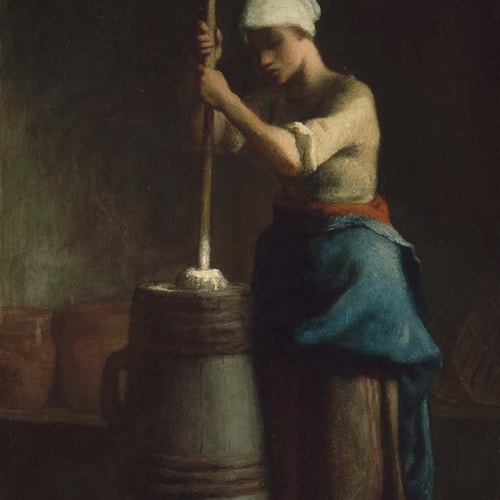
Butter has accompanied livestock-raising peoples around the world for longer than one might think.
The oldest "written" trace dates back 4,500 years and is engraved on a limestone tablet from the Sumerian era, preserved in the Baghdad Museum. The scene depicts workers milking cows on a large estate and producing butter in a primitive "zngola." This was nothing more than a large jar containing milk, in which the liquid was swayed back and forth.
Antiquity The oldest "written" trace dates back 4,500 years and is engraved on a limestone tablet from the Sumerian era, preserved in the Baghdad Museum. The scene depicts workers milking cows on a large estate and producing butter in a primitive "zngola." This was nothing more than a large jar containing milk, in which the liquid was swayed back and forth.
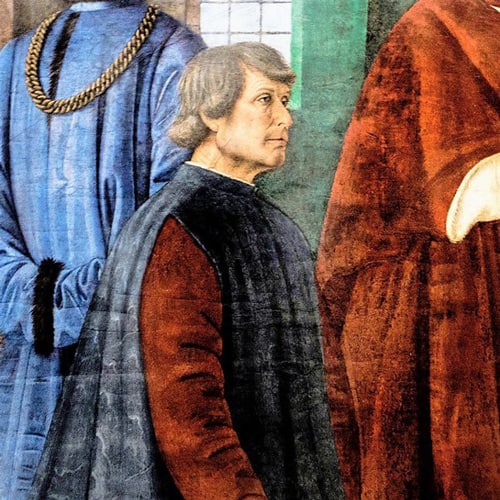
From Libro de Arte Coquinaria, a 15th-century cookbook written in the vernacular, dating to around 1460.
"Take, as mentioned above, one pound of peeled almonds and grind them very well. Mix them with half a glass of rose water and strain them through a cloth, pressing tightly. To help them bind well, add a little starch flour or, even better, half a glass of pike broth with four ounces of sugar and a little saffron to give it a yellow color. Strain everything as tightly as possible. Then, shape it like a loaf of butter and leave it to set overnight in a very cool place."
Maestro Martino da como "Take, as mentioned above, one pound of peeled almonds and grind them very well. Mix them with half a glass of rose water and strain them through a cloth, pressing tightly. To help them bind well, add a little starch flour or, even better, half a glass of pike broth with four ounces of sugar and a little saffron to give it a yellow color. Strain everything as tightly as possible. Then, shape it like a loaf of butter and leave it to set overnight in a very cool place."